


Tetyana Popova: “Culture is an asset. It needs to be systematically protected during changes”
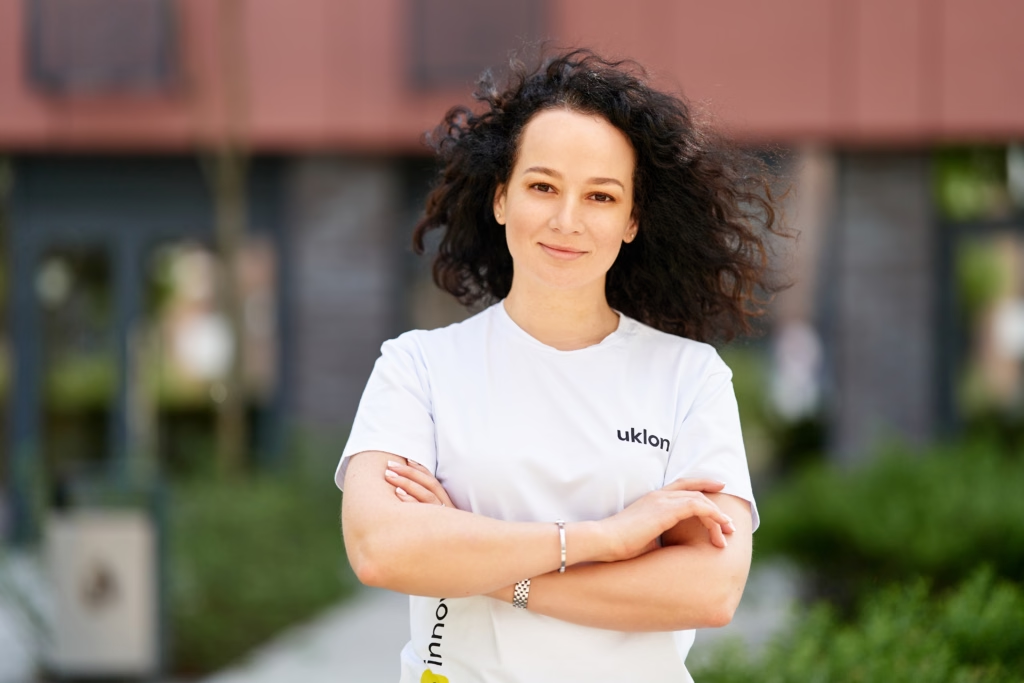
In her speech at HRWS, Tetyana Popova, Human Resources Officer at Uklon, presented a case study on how the company went through large-scale transformations—the deal with Kyivstar, the group’s Nasdaq IPO, a new organizational model—and managed to preserve its corporate culture as a strategic asset.
Culture as a Strategic Asset
Tetyana Popova, who has been with the Uklon team for 11 years, recalled that she originally joined the company as the sole HR teammate, whereas today the HR department counts 54 employees. The expansion of the HR function’s personnel is fully justified, as the scope of tasks during this time has grown significantly. Indeed, Uklon has navigated many complex and crucial changes, including expansion into new markets and launching new products, growth during wartime, the deal with Kyivstar, the group’s Nasdaq IPO, and ultimately the transition to a new organizational model. Throughout all of this, it was crucial not to lose its own corporate culture, which had developed in the company over the years and made it effective.
“All transformations showed us that corporate culture is not just an atmosphere, but a company asset that requires systematic work. Corporate culture helps navigate all changes within the company, but it also carries the direct risk of diluting under pressure,” says Tetyana Popova.
According to her, the deal with Kyivstar was a turning point, and the main question for Uklon was how to become part of a global group without diluting its own DNA.
“And this is not about how we should change and adjust, but specifically about how we preserve and reinforce what makes Uklon so strong,” says Tetyana Popova.
Five Steps to Preserve Culture
Uklon built five steps to preserve its own DNA, which, according to Tetyana Popova, will be useful to any company undergoing change.
Step 1 — Systemic communication as a trust tool
During transformations, communication ceases to be a “support function”—it becomes critical for building trust.
“During any change or transformation, there is a very high risk of uncertainty among the team. Employees ask what exactly will change, how it will affect the company, how the management system will change, and overall, what will happen to me, my teammate, and specifically my role. Therefore, our primary task was to give the team clarity,” explains Tetyana Popova. According to her, the company created a single communication platform for change management, which became part of regular communication focused on proactive informing.
In practice, the following was implemented:
-
A single platform for change communication
-
Informing the team prior to external stakeholders
-
Explaining not only facts, but also context
-
Holding Q&A sessions with the founders and Oleksandr Komarov
-
Preparing managers to cascade information
-
Engaging People Partners to handle individual employee triggers
Step 2 — Reinforcing the role of corporate culture in HR
Uklon merged communication, culture, engagement, and employee experience into a single unit.
“Culture became not just a set of initiatives, but part of systemic change management,” notes Tetyana Popova. The new Culture & Employee Experience unit became an integrating function between HR and business results.
Step 3 — Synergy between Uklon’s culture and the group’s culture
The team aligned Uklon’s values, work principles, and behavioral indicators with those of the group.
“We do not replace our culture with the group’s culture or lose our identity; rather, we are strengthened by the additional patterns that came to us alongside the group,” says Popova.
Key principles during integration were:
-
Finding common meanings and points of reinforcement
-
Preserving identity
-
Finding ways to strengthen culture at a new scale
Step 4 — A new platform-based organizational structure
There were concerns that processes would slow down within the group. However, the opposite happened—the company began working faster.
“We ran faster because we gained new opportunities, as well as expectations from the group regarding our results, implementations, and scaling,” explains Tetyana Popova.
Uklon studied models from Amazon, Spotify, and Uber and transitioned to a platform structure:
-
Business Units — Responsible for product/service/country performance.
-
Platforms — Centers of expertise that scale policies, tools, and standards.
In this model, HR took on the role of establishing unified standards regarding corporate culture, its values, and behavioral patterns, as well as controlling compliance to prevent the emergence of “subcultures.”
Step 5 — Aligning teams through goals and rhythm
Tetyana Popova emphasizes that values are an important foundation of culture, but on their own, they do not synchronize the daily decisions, priorities, and work of different teams. That is why Uklon developed an annual alignment cycle—a regular management rhythm that helps synchronize leaders, teams, goals, and key decisions. It includes:
-
Strategic sessions for management and the board
-
Leadership Summit
-
Cascading OKR system
-
Quarterly progress reviews
-
Monthly meetings with the CEO
-
Semi-annual offsite sessions for management
Key Insights
Among the conclusions Tetyana Popova offered during her presentation, the following stand out:
-
Company culture must not be a casualty of growth
-
During transformation, people need clarity and context
-
A strong culture must be supported by structure
-
Integration works better when there is a shared framework
And most importantly, it comes down to how much employees believe in the company’s DNA.
Regarding the results, Ms. Popova highlighted two key metrics from an HR perspective: first, not a single employee left the company due to the changes; second, the eNPS in the year following the deal increased by 11%.
The original material was published on the Dilo.ua website.
