


Behind the scenes at Uklon: Chief Ride-hailing Officer on the market, drivers, and their fleet. Olena Orlova interview with The Page

Olena Orlova, Chief Ride-Hailing Officer at Uklon, spoke with a journalist from The Page to discuss the specifics of operating the service in different regions, the evolution of ride-hailing, new digital services, the composition of Uklon’s drivers, and the characteristics of their fleet.
The full interview is published on The Page website.
As a major player, you obviously monitor the balance of power in the Ukrainian ride-hailing market. How do you assess the market shares of Uklon and other players? How have they changed recently?
To start, I would like to look at the broader evolution of the ride-hailing market in Ukraine. Few people realize that the Ukrainian company Uklon is almost the exact same age as the American Uber; we developed and launched our products almost simultaneously. We began operating in 2010, and our mobile apps were released in 2012–2013. Their popularity among users surged between 2015 and 2018, when 3G and 4G technologies arrived in Ukraine. Of course, without fast mobile internet and smartphones, a ride-hailing product fundamentally cannot exist. Because of this, our active operations in the Ukrainian market as a classic ride-hailing service began significantly later, whereas it had already become widespread in America and Europe by that time. Regarding market positioning in Ukrainian ride-hailing, we actually lack open sources. I can only dream of having measurement panels like Nielsen, as they do in retail, which provide a clear understanding of everyone’s position. The ride-hailing market lacks such tools, but there is data we all rely on—for example, the monobank dashboard. There, we can see that since the beginning of the full-scale invasion, Uklon has held a leading position in the ride-hailing market, and this leadership is strengthening both in the number of rides and in financial volume. I should add that in some cities we maintain absolute leadership, while in others we compete with other national or even highly local ride-hailing players. For instance, in Kharkiv—a city of over a million people—there is very fierce competition with a local player.
How many active clients currently use Uklon, and how are they distributed across the cities where you operate?
I want to start with the figure of 35 million. That is the current number of downloads of Uklon mobile apps in the Ukrainian and Uzbek markets. Speaking of the client base, in the first quarter of 2026, it reached 5.1 million active users. These are the people using our digital products in Ukraine and Uzbekistan. As for the cities, as I mentioned earlier, our positions vary quite a bit. In Western Ukraine, there are cities where we would still like to achieve leadership. For example, we see growth potential in Chernivtsi. Odesa is a very interesting region for which, as we have already realized, nationwide approaches and campaigns do not work. It is a special city that requires a unique key.
And this year, we have already launched a campaign there that you won’t see in other Ukrainian cities. For instance, you can ask the driver to turn on an audio guide and listen to one of three podcasts about the city’s history while riding through Odesa. In this way, we are trying to win Odesa’s favor, as we see growth potential there.
Do you compete with local operators in Odesa?
Yes, there are some fairly small local players. Visitors from Kyiv, Lviv, or Dnipro might not know about them, but locals use them actively. Therefore, in Odesa, it’s important for us to work with both audiences: locals and tourists, who make up about a third of the entire client base during the summer season.
How many Ukrainian cities does Uklon currently cover, and in which new cities might it appear?
Our focus is on cities with a population of 200,000 or more, as we see the potential to ensure a balance between supply and demand there. Since we are a platform, it is important for us to cater to two target audiences: the driver and the rider. The challenge in smaller cities is that we might not be able to build a sufficient driver base to meet the demand of our riders, for example.
In terms of potential, we are already one of the key players in most Ukrainian cities. For example, we are the absolute leader in Bila Tserkva, which is close to Kyiv. And here, in particular, the “Intercity” class is developing. But there are also cities with untapped potential—like Chernivtsi or Odesa, which I mentioned earlier. In total, Uklon operates in 27 Ukrainian cities and the Bukovel resort. These locations generally meet the 200,000-resident criterion. In Kyiv, 74% of our clients find a car in less than a minute, which is a very high quality standard that is crucial for us to maintain. This means we are one of the leaders in the capital. Of course, we are constantly exploring opportunities in new cities. But right now, we see potential not only in expanding our core service—ride-hailing—but also in transforming into an ecosystem.
What exactly is the transformation that Uklon is currently undergoing?
This is very important to us. Already today, you can find services on the platform such as delivery, roadside assistance, a marketplace where you can order flowers, and a Travel section where you can purchase bus tickets. In the near future, new services will be introduced to our product ecosystem. Therefore, our focus is shifting towards covering a maximum of diverse user needs within our platform and providing our existing ride-hailing client base with additional services for a comfortable lifestyle.
Since all of this is integrated into a digital platform, could you tell us how it has been developing recently? Do you perhaps have any upcoming updates to announce?
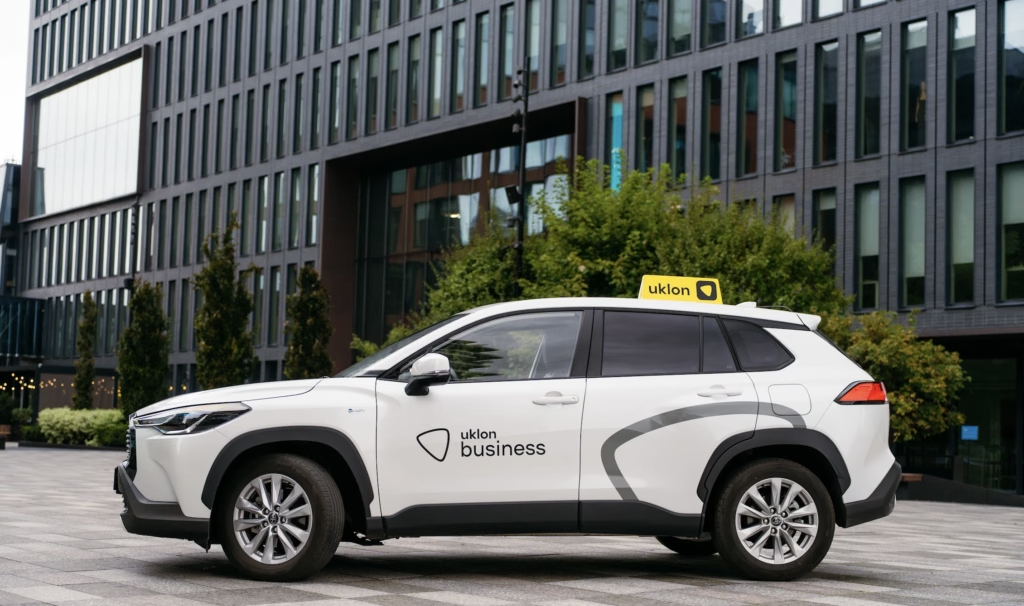
We can divide our development directions into two parts: the core ride-hailing service itself and our overall global Uklon ecosystem. Speaking of the ride-hailing service, we are focusing on developing our vehicle classes. Users know that we offer, for instance, the “Business” and “Prime” classes, as well as the “Kids” class for passengers with children, where the driver arrives with a child car seat. Currently, we have a strategic focus on developing the “Kids” class, as we see significant potential there. Therefore, in the near future, we will enhance this class with new products and features for our clients. Then there is the “Basic” class, which we launched in June 2026 and haven’t spoken much about publicly yet. It is currently in an active testing phase in Kyiv, effectively covering only certain hours and areas. It caters to clients for whom the specific car, service level, and quality are less important than the price. We are still testing this class but plan a large-scale launch later this year.
Additionally, at the end of last year, we introduced a “ski equipment” add-on for ski resort visitors, which can be selected when booking a ride. In this case, a “Universal” (station wagon) class vehicle, capable of accommodating such luggage, will arrive. Returning to our global ecosystem, our marketplace will certainly not be limited to just flowers, and consumers will soon see new categories there. We also aim to make ticket booking available for as many transport categories as possible. We will have some news to share on this front as well. Overall, in synergy with our key investor, Kyivstar, we are preparing a range of products that will allow users to gain maximum value from our partnership.
Within all these areas of development, I would specifically like to mention inclusion. How is Uklon integrating it into its service?
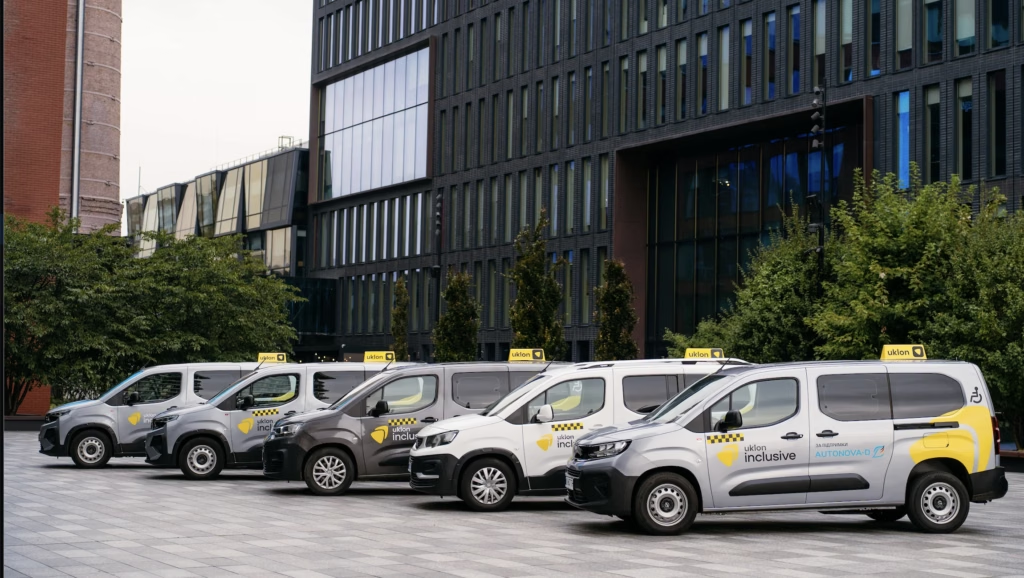
Uklon’s “Inclusive” class is also gaining momentum, and we plan to scale it this year. So there will be news and announcements. As of now, the “Inclusive” class has already completed over 40,000 rides. It is currently available in the cities of Kyiv and Lviv. Accordingly, Kyiv accounts for about 33,000 rides and Lviv for 7,000. In total, 10 vehicles and specially trained drivers are involved, providing high-quality service to our clients with disabilities. It is important to add here that this is not a commercial project for the company, but rather a response to a societal need. Therefore, we plan to strengthen and scale it, considering that according to the Ministry of Social Policy, there are already more than three million people with disabilities.
After high-profile accidents in Kyiv, the issue of taxi drivers’ compliance with traffic rules has become acute. Does Uklon monitor its drivers based on this criterion, and do regular traffic violators risk losing access to the platform?
I would like to start not just with the driver who is already fulfilling orders, but from the moment of registration with our service, since the first contact happens when a person does not yet have access to our platform. Here, we have an entire team that communicates with drivers both personally and in an automated mode, conducts photo control of documents, and checks available state registers for both the vehicles and the drivers themselves for violations. Only if there are none is a driver allowed to use our service. If two or more violations are found within a year, we do not permit drivers to work on the platform.
The next stage occurs while they are actively using our service. Since we have our own mapping system that powers our app, when the system detects that a driver is speeding, we send them a warning requesting them to slow down. If a driver receives a negative rating of one to three stars from our passengers along with a complaint about their driving style, our contact center operators process these requests and do everything possible to ensure the driver does not repeat the violation. In other words, our company’s goal is to prevent drivers from receiving repeated complaints. Consequently, taking all these factors into account, we can block a driver either temporarily until the circumstances of the violations are clarified, or permanently if we identify critical issues.
Could you clarify, does absolutely every traffic violation become a “red flag”? After all, a taxi driver who spends a long time behind the wheel has a higher risk of making minor infractions. On the other hand, how do you verify passenger complaints? Because people often give subjective ratings, and unfortunately, there is a lot of aggression in society right now.
Let’s start with the classification of traffic violations that act as a “red flag” for us, versus what we consider just background. During registration, the violations that matter to us are those proven in court. So, indeed, this is far from all traffic violations. Next, I would like to note that according to our internal data, only 0.09% of orders actually result in complaints that truly require urgent processing and additional attention from the company. After all, 99.91% of rides go without any issues. If we do receive such a complaint, it is important for us to look at it from three sides. Of course, we pay attention to who is submitting the complaint, its reasons, objectivity, and tone. It is also important for us to hear the driver and how they explain the situation. Thirdly, we are quite a tech-driven company, so we look into our systems at the history of both the passenger and the driver: what kind of relationship we have, how long-term it is, and whether there have been complaints against either party before. That is, we pull up the entire history of our interaction and cooperation. And then we analyze the ride itself: whether there really was, for example, speeding. The insights we gain through big data add to our objectivity.
Staff shortages have become an urgent problem in Ukraine in recent years. How does the lack of workforce affect your operations?
First of all, let me remind you that we are a product IT company, and Uklon drivers are not our employees. But, unequivocally, we feel the impact of the personnel crisis. For example, five years ago, we severely lacked IT developers to make our product what you see today. But today, the staffing crisis has transformed and spread to administrative functions, and we are short of marketers, middle management, and so on. Speaking specifically about the driver base, a turning point was September of last year, when Ukraine opened its borders for men under 25. At that time, we observed a drop in the share of young male drivers in favor of an older demographic.
On the other hand, the population from the eastern and southern regions continues to migrate closer to the center and west of Ukraine. For example, in Kyiv, many internally displaced persons collaborate with the platform, as it provides an opportunity for quick income. Therefore, we are not currently suffering from an acute shortage of drivers, but we do feel a redistribution of the driver base working with us.
Are the drivers working in the system currently able to meet the demand, especially during peak hours?
Generally speaking, demand and supply are actually balanced. Of course, there are peak hours when there is a hyper-load on our drivers and a temporary shortage of them. That’s when the client starts competing for their ride with the price, and thanks to this, the driver chooses that order. For our part, we can offer drivers additional benefits in those sectors that truly have bigger issues with fulfilling rides. In other words, we incentivize drivers to migrate from one district to another where excessive demand arises. By the way, over 100,000 active drivers work in the system over the course of a month. There are also those who just log into the app but do not take orders. And this represents our potential for growth.
How are women represented among Uklon drivers, and has their share been increasing lately?
Currently, we are seeing a very strong upward trend in the share of female drivers in our service. Right now, they make up about 4%. Just two years ago, it was only 0.5%. To support them, and in response to a request from the female community, last year we launched the “Women’s” class, which allows female drivers to fulfill orders and female passengers to use the services of a female driver.
How many orders per day do drivers usually fulfill, and what groups are they divided into based on this criterion?
There is a segment of drivers who, on their way to or from work, take literally a few orders a week just to cover the cost of fuel and car depreciation, and they do not work in the ride-hailing service as their main job. Then there are drivers who collaborate with the platform permanently, and it is their main source of income. Such drivers can fulfill over 450 orders per month, whereas the average per driver for this period is about 120 orders. For these drivers, customizable filters are important so they can adapt the working conditions to themselves. And we are constantly improving the product to benefit our regular drivers.
You probably also have a cross-section of data about the cars used by Uklon drivers. What is the structure of the Uklon driver fleet by fuel type? What is the average age of the cars and the most popular brands?
The average age of a car is currently about eight years. I already mentioned the classes we have available, and naturally, one of the key differences between them is the quality and models of the cars. Drivers understand that a higher standard of car provides the opportunity to work in a more expensive class, and consequently, to earn more. Therefore, we are seeing a trend towards fleet improvement. While previously the most popular cars were, for example, the Renault Logan, today they are more expensive vehicles: Nissan Leaf, Toyota Prius, and Toyota Camry, respectively. Gasoline and gas, strange as it may sound, are still the fuel for the vast majority of cars working in the service (over 50%). But the share of electric cars is actively growing.
